How to Do a Weekly Review That Actually Makes You a Better Founder

The Compass Team
March 26, 2026 · Updated September 2, 2026
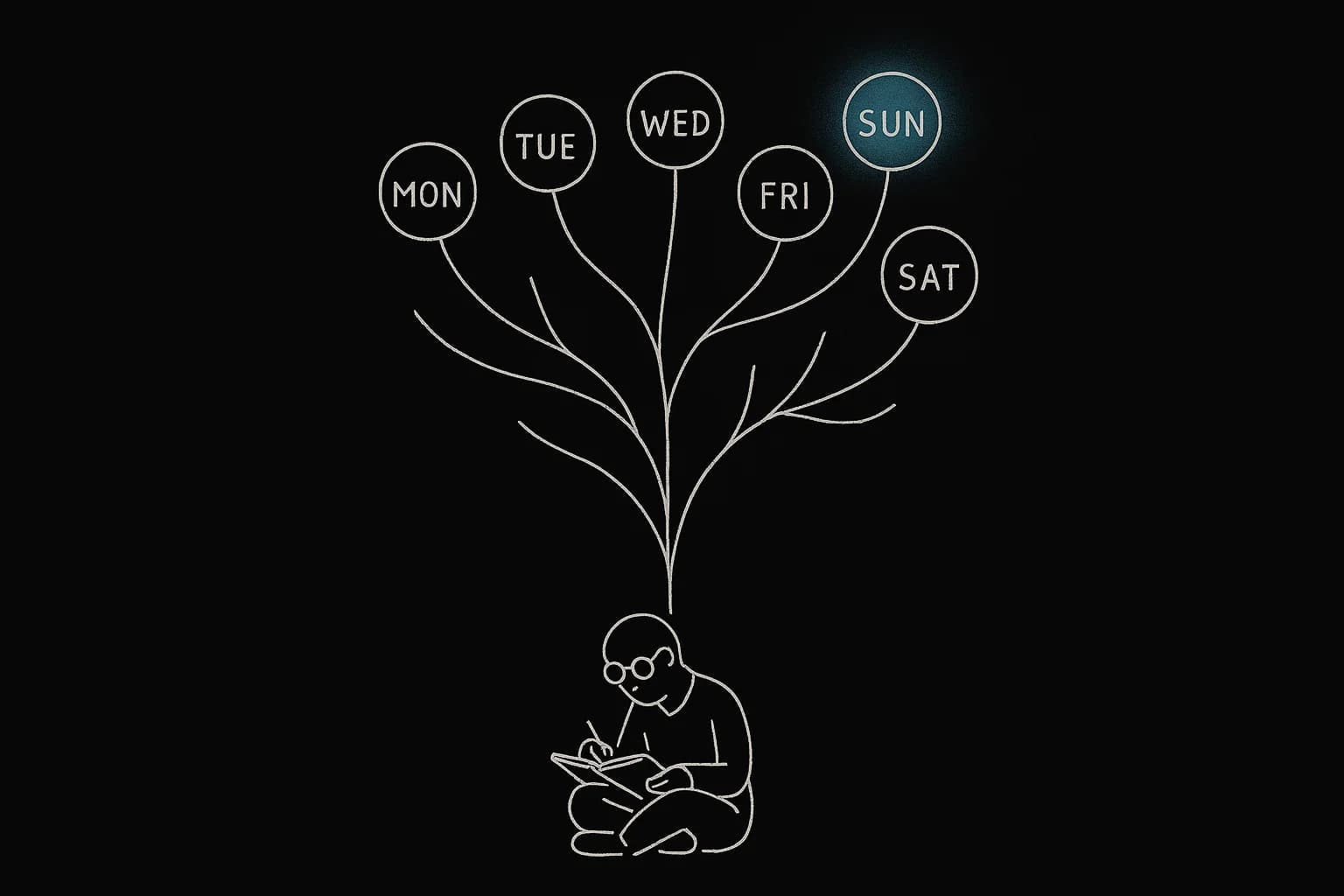
You already know you should do a weekly review. You've probably tried: maybe with a Notion template, maybe a bullet journal, maybe just staring at your calendar on Sunday night and sighing.
And it probably didn't last. Not because you lack discipline, but because the weekly review you tried was designed for project managers, not founders.
A project manager's weekly review asks "what got done?" A founder's weekly review should ask "am I becoming a better founder?"
That's a different question entirely. And it needs a different process.
Why most founder weekly reviews fail
Let's be honest about what's actually happening when founders attempt weekly reviews:
Failure mode #1: The to-do list audit. You open your task manager, check off what got done, move what didn't to next week. Congratulations, you've accomplished nothing. You already knew what was on the list.
Shuffling tasks between weeks doesn't produce insight.
Failure mode #2: The guilt trip. You look back at the week and realize you didn't ship what you planned. You feel behind. The review becomes a mechanism for beating yourself up, which makes you avoid doing the next one.
Cycle repeats.
Failure mode #3: The Notion cathedral. You spent 3 hours building a beautiful weekly review template with linked databases, rollup properties, and a rating system for how you felt about each day. You used it twice. The template was the project, not the review.
If you've tried this path, you're not alone. Notion is great for docs but tends to turn reflective practices into engineering projects.
Failure mode #4: The "I'll do it in my head" bypass. You mentally scan the week while showering or driving. You have a few insights. They evaporate by Monday morning.
Nothing compounds because nothing was captured.
All four failures share a root cause: the review has no connection to your actual thinking during the week.
If you're not capturing your thoughts as they happen, there's nothing meaningful to review. And if your review is just looking at tasks and calendars, you're reviewing your output, not your thinking. Those are very different things.
The framework
What follows is the framework I wish someone had given me two years ago. It takes about 45 minutes. It works whether you're a solo founder, have a co-founder, or run a team of 20.
The only prerequisite is that you've been logging your thoughts during the week, even if it's just quick voice notes or 2-sentence entries.
We talked about building a daily capture habit in our journaling framework post. This weekly review is where that daily capture becomes compounding insight. Capture is step 1, review is step 2.
One without the other is incomplete.
Step 1: The brain dump (5 minutes)
Before you look at anything (calendar, tasks, metrics, Slack), sit down and write out everything that's on your mind. No structure. No editing. Just dump.
What's stressing you out? What are you excited about? What's nagging at you that you've been avoiding?
What felt different about this week?
This matters because your unfiltered state at the end of the week is data. It tells you what your subconscious has been processing, which is often more telling than what your conscious mind chose to focus on.
Set a timer. Five minutes. Don't stop writing.
Step 2: Review your week's notes (10 minutes)
Now go through whatever you captured during the week: journal entries, voice memos, meeting notes, random thoughts you jotted down. Read them chronologically.
You're not looking for action items. You're looking for patterns:
- What topics kept coming up across different days?
- What decisions did you make that you're now unsure about?
- What did you say you'd think about later, and never did?
- Where did your energy spike? Where did it crater?
- What conversations changed how you think about something?
This is where founders who context-switch constantly get the most value. Your week probably felt like disconnected chaos: product, then sales, then hiring, then fundraising, then ops. The review is where you spot the hidden threads connecting them.
Write down 3-5 patterns or observations. Don't force them. If you only see 2, that's fine.
Step 3: The three questions (15 minutes)
This is the heart of the review. Answer these three questions in writing:
1. What did I learn this week that changes how I think about my company?
What specifically shifts your model of the business, the market, or your strategy? Maybe a customer conversation revealed a use case you hadn't considered. Maybe a metric moved in a direction that challenges an assumption.
Maybe you realized your roadmap is solving problems that don't exist.
If the answer is "nothing," that's a signal too. You might be in execution mode when you should be in learning mode (or the other way around).
2. What's the single most important thing for next week?
One thing. The thing that, if it gets done well, makes everything else easier or irrelevant.
Founders are terrible at this because everything feels urgent. Force yourself. If you could only accomplish one thing next week, what would it be?
3. What am I avoiding?
This is the question that separates useful weekly reviews from performative ones. Something is always being avoided.
A hard conversation. A feature you know needs to be cut. A hire that isn't working out. An investor update you don't want to send because the numbers aren't great.
Name it. You don't have to fix it this week. But naming it is the first step to removing the cognitive tax it's been silently imposing on everything else.
Step 4: Update your operating context (10 minutes)
This step is what makes the review compound over time instead of being a standalone exercise.
Take what you learned and update the documents that drive your week-to-week execution:
- Your priorities list: Does the #1 priority still make sense? Reorder if needed.
- Your assumptions log: What assumptions did you validate or invalidate this week? Update accordingly.
- Your open questions list: What new questions emerged? Which old ones got answered?
- Your "not now" list: What did you say no to this week? (This list becomes incredibly valuable after 3-6 months. It's a record of strategic discipline.)
This is where most people stop because it feels like admin work. It's actually the mechanism by which your thinking compounds. Without updating your external thinking system, each week starts from scratch. With it, each week builds on the last.
Step 5: The look-ahead (5 minutes)
Glance at next week's calendar. Not to plan every hour, just to answer:
- What are the 2-3 moments that will disproportionately matter? (A key meeting, a launch, a deadline.)
- Is there space for the #1 priority from Step 3, or do I need to create space?
- Is there anything I can cancel or delegate to protect focus?
Then close the review. Don't keep tinkering. The value is in the 45 minutes, not in the optimization theater afterward.
How this compounds over time
Here's what I've seen happen when founders stick with this for a few months:
Around week 4, you start noticing patterns that span multiple weeks. "I keep saying hiring is my priority but I keep ducking the sourcing calls." The review becomes a mirror that won't let you bullshit yourself.
Around week 8, your "What did I learn" answers get sharper. Instead of surface-level observations, you're synthesizing across months of data. Your strategic thinking improves because it's building on a written record, not on memory (which is unreliable and biased toward whatever happened Tuesday).
Around week 12, you have a quarter of operating context documented. When someone asks "why did you decide X?" you can trace the reasoning.
When you're making a new decision, you can reference what you learned in analogous situations weeks ago. Your decision quality improves because you've removed the thinking bottleneck. Your past thinking is accessible, not lost.
This is the compounding effect that founders who "just think in the shower" never get. Writing is thinking, but only if you revisit what you've written. The weekly review is the revisiting.
Common objections
"I don't have 45 minutes." You spent more than 45 minutes this week on things that didn't matter. You know it. The review is what helps you identify and reclaim that time.
"I can't do it consistently." You don't need to be perfect. Three out of four weeks is enough for compounding to kick in. Skip one when life is genuinely on fire. Just don't let the skip become a habit.
"My week is too chaotic to review." Chaotic weeks need a review most. That's when you're most likely operating on autopilot, reacting instead of deciding. The review is where you step back and figure out what actually happened versus what it felt like happened.
"Can't I just use Day One / Apple Notes / a blank notebook?" You can try. But personal journaling apps are designed for diary entries, not founder operating systems.
Day One and blank notebooks are passive. They store what you put in and give you back exactly that. They don't help you see patterns, surface themes, or connect this week's thinking to last month's.
Making it stick
The framework above works on paper. You could literally do this with a notebook and a pen. But it works better with a system that strips friction out of every step.
That's why we built Compass. Daily capture happens through voice notes you can log in 30 seconds, quick enough to grab a thought between meetings without breaking your flow. The AI categorization structures your entries automatically, so when Friday's review rolls around, you're not wading through a wall of undifferentiated text.
Where it really pays off is Step 2. When you review your week's notes, Compass surfaces patterns for you. It connects themes across entries, flags recurring topics, and shows you what your week was actually about (not just what your calendar said it was about).
Your thinking gets captured and compounded.
The weekly review is the most productive 45 minutes of your week. Start this Friday. Keep it rough. The polish comes from doing it, not from designing the perfect template.
Share this article