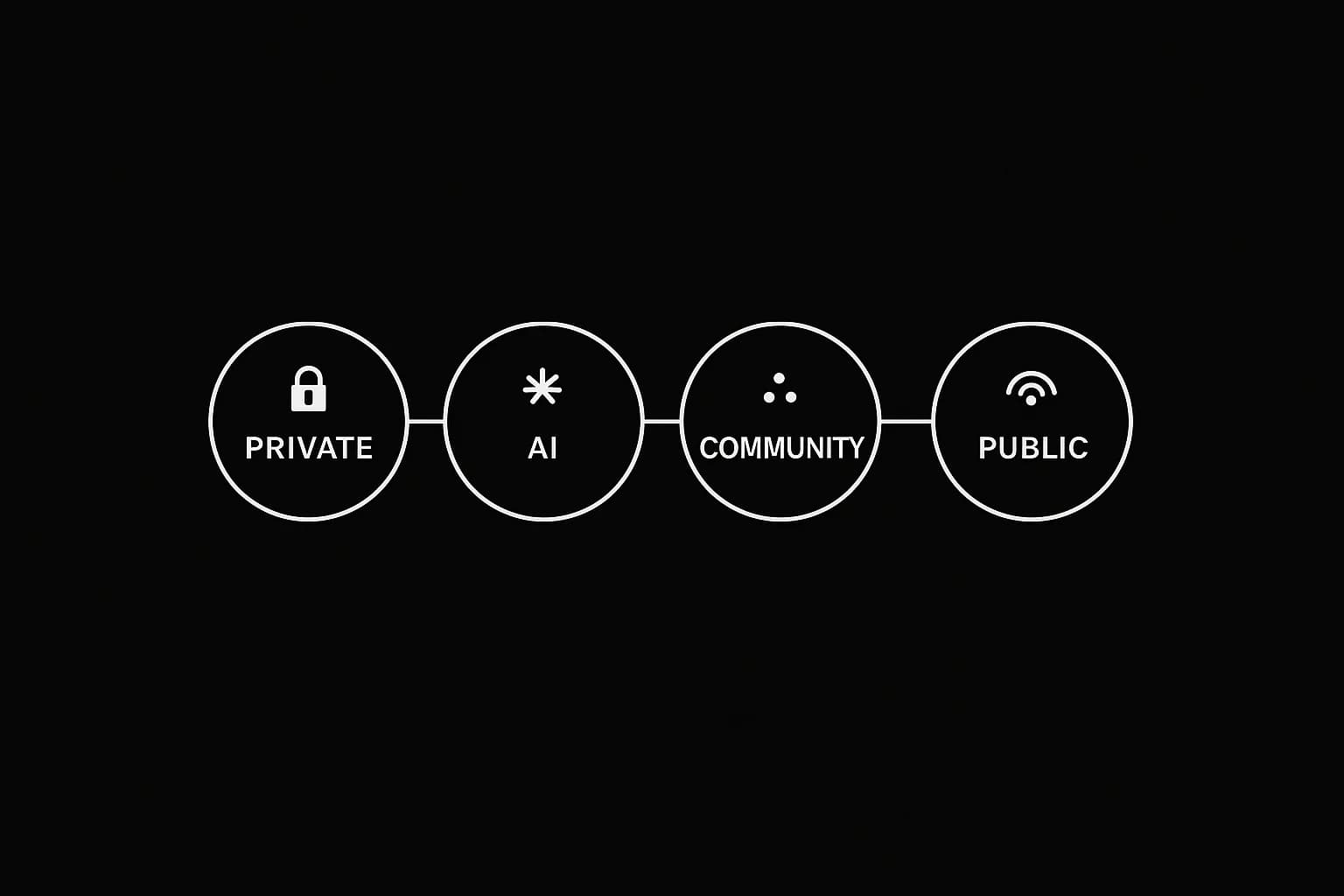
The Four Lives of a Founder's Note: Private, AI, Community, Public

The Compass Team
April 4, 2026 · Updated September 2, 2026
Last Tuesday I wrote 4 notes during a single coffee.
One was a half-formed worry about runway. One was a question I wanted to ask another founder. The third was a 3-line product idea I'd been chewing on for weeks. The fourth was a story about a support ticket that made me feel like an idiot.
By Friday, all 4 had turned into different things.
The runway worry stayed in my private journal and probably always will. The founder question got dropped into a 5-person Telegram thread and pulled 6 replies in 20 minutes. The product idea became a tweet that did 80k impressions. The support story became this paragraph.
Same author, same week, 4 completely different audiences.
Most notes apps can only handle one of those four. They treat a note as one thing, with one home, written for one reader (usually you, later, when you've already forgotten about it).
Real founder notes don't behave like that. A note has a lifecycle, and the lifecycle has 4 layers.
Layer 1: Private
This is the layer most apps actually optimize for, and the one most founders still drown in. Raw capture. Voice memos at 2am. Half-finished thoughts you don't want anyone to see, including future you.
The point of the private layer is permission.
You need a place where you can write "I think my cofounder is checked out" or "I have no idea what I'm doing this quarter" without performing for anyone. If your notes app makes you feel watched, you'll write a sanitized version of your actual thinking. The sanitized version is worth nothing.
Day One nailed this 10 years ago for personal journaling. Most "founder" tools forgot it existed. (We wrote a whole piece on why over at Compass vs Day One.)
Test for this layer: would you write the worst sentence about yourself in it? If no, your tool is wrong.
Layer 2: Internal (AI Context)
Almost no tool builds for this layer. It's the one that matters most over the next 18 months.
When you write a note, you're also feeding a model. Not in a creepy training-data way. In a "this is my context window" way.
The notes you take this week are the difference between an AI that gives you generic startup advice and an AI that knows your runway is 9 months, your last 2 hires didn't work out, and your kid was born in February.
Most notes apps bolted AI on as a feature. A button that summarizes. A sidebar that suggests tags. The AI never actually reads anything you wrote last quarter, because the architecture treats your notes as documents instead of context.
Your notes are the corpus. Every AI tool you touch should be reading from the same well.
That's what Compass is built around. Capture goes into a structured layer an LLM can query, so when you ask "what was I worried about last quarter," you get an answer grounded in your own writing instead of a hallucinated pep talk. The longer version of why this matters lives in the thinking bottleneck piece.
Test for this layer: ask your notes a question. If the answer is "search returned 47 results," the layer doesn't exist yet.
Layer 3: Community
Between "for me" and "for the internet" there's a layer most tools pretend doesn't exist. The small group. 5 founders in a Telegram thread. Your investor Slack. The 12 people who'll tell you the truth before you embarrass yourself in public.
Notes that go here are weird hybrids. They carry enough context to be useful (because the readers know you), and they're not polished.
You can ship a half-baked idea and get sharpened. You can ask a dumb question and get a non-corporate answer. You can confess that the launch flopped and get something more useful than "you got this 🙌".
The mistake founders make at this layer is performing. Treating community notes like public content. Optimizing for likes from the 8 people who already know your real cap table. If you do that, you've broken the only group of humans who'll save you from a bad call. Keep it ugly. Keep it asking.
Compass lets you push selected notes straight into a thread without rewriting them. Which sounds boring until you realize it's the difference between asking your group 6 real questions a week and asking them zero.
A sub-layer worth naming: the long memo
Sometimes a community note is a 1,000-word memo to 5 people.
Strategy doc for your cofounder. Quarter recap for your board. Technical writeup for the 2 engineers with full context.
These are the most valuable things you write all week. They're also the worst-served by the existing tools. Notion is too heavy. Email is too final. Google Docs treats them like 50-page contracts. The right home is somewhere between a long note and a short essay, drawn from the same well as everything else you've captured.
Layer 4: Public
This is where most "build in public" advice falls apart. Founders get told to post more, post daily, post in public. So they sit down at 9pm with a blank tweet box and try to manufacture insight at the end of an exhausting day.
Insight comes from a backlog.
The founders who post good public content all week have been writing notes in layers 1, 2, and 3 for months. The public posts are the top 5% surfacing. Creativity has nothing to do with it.
The pipeline looks like this:
- Private capture (raw, 2am, ugly).
- AI surfaces a pattern across 30 of those notes.
- You drop the pattern in your founder group, get pushback, sharpen it.
- The sharpened version becomes a tweet. The tweet that lands becomes a blog post.
Skip any of those steps and the public layer feels like grinding. Run all 4 and the public layer is a byproduct. The longer version of this argument is in build-in-public content without burning out.
Why most tools die in a single layer
Pick any popular notes app and ask which layer it's actually built for.
Notion is layer 3 with delusions of layer 2. Day One is layer 1 with no idea layers 2 through 4 exist. ChatGPT is a half-built layer 2 with no memory of yesterday. Twitter is layer 4 with no roots underneath.
Each one is fine inside its own layer. None of them carry a single thought across all 4. Founders end up duct-taping 5 apps together, copy-pasting the same idea into different windows, losing 80% of the signal in transit.
A note is raw material that wants to move. The job of a founder's note-taking system is to give the note somewhere to go next.
That's the bet behind Compass. One capture surface, 4 layers underneath, and a model that knows the difference between a 2am voice memo and a 1,000-word memo to your board.
If you want to see the daily loop in detail, the founder journaling system piece walks through how the daily, weekly, and monthly cadence works in practice. And if you're trying to figure out which tool belongs where, the comparison of 9 founder note-taking apps is the cleanest map we've got.
The founders who compound the next 5 years will be the ones whose notes refuse to die in a single layer.
Share this article